


Hero In Art - The Vanished Traces Of Richard Hambleton
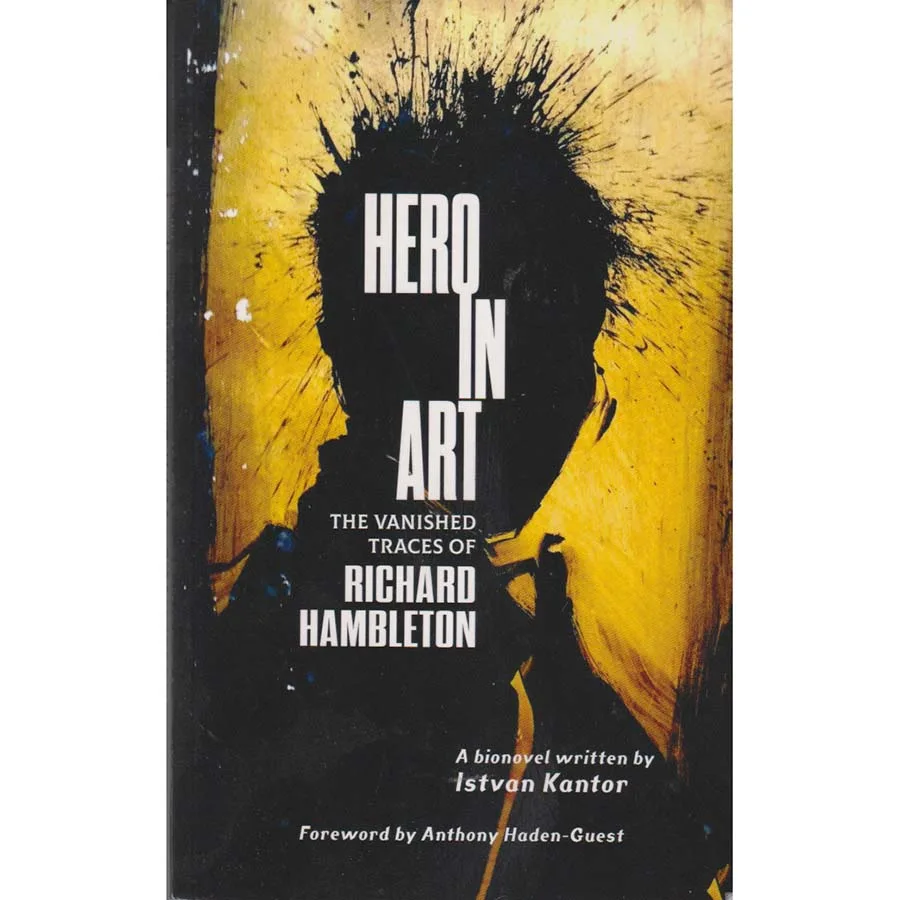
Publisher: Autonomedia
Format: Paperback
ISBN: 9781570273667
Hero in Art – The Vanished Traces of Richard Hambleton (2020) by Istvan Kantor – Autonomedia – As New Condition
Some artists put their work in galleries.
Richard Hambleton put his on walls in dark streets and allowed rain, demolition, other graffiti artists and New York City itself to decide how long it remained there.
Which, from an investment point of view, was perhaps not the most efficient approach.
In Hero in Art – The Vanished Traces of Richard Hambleton, artist and writer Istvan Kantor tells the turbulent story of one of the great figures of the early New York street-art underground: a contemporary of the scene that produced Keith Haring and Jean-Michel Basquiat, but a considerably darker and more elusive presence.
Hambleton became famous for his sinister Shadowman figures — rough black human silhouettes painted suddenly onto walls, alleys and doorways, often positioned so that they appeared to be lurking, falling, fighting or preparing to do something that would probably justify crossing the street. He also created the provocative Image Mass Murder works, placing painted outlines and splashes resembling crime scenes in public spaces.
It was street art before street art acquired respectable galleries, auction estimates, branded trainers and people drinking complimentary prosecco while discussing its authenticity.
The original works belonged to the city.
And the city was not particularly interested in conservation.
Walls were demolished. Paint faded. Buildings were renovated. New graffiti went over old graffiti. Hambleton’s figures appeared, frightened or intrigued passers-by, and gradually vanished back into the urban landscape from which they had emerged.
Hence the title: The Vanished Traces of Richard Hambleton.
Kantor is not observing all this from the comfortable distance of an art historian who arrived decades later with an archive and several footnotes. Also known as Monty Cantsin, Kantor was himself an artist, founder of Neoism and an early friend of Hambleton. His book is described by the publisher as a biographic novel, combining personal recollection with the memories of others to construct a deliberately immediate account of Hambleton’s life, art and surrounding underground culture.
Consequently this is not merely the familiar tale of a Great Artist progressing efficiently from youthful promise to gallery representation, international acclaim and tasteful retrospective.
Hambleton’s trajectory was considerably messier.
There was fame.
There was obscurity.
There was artistic brilliance.
There were drugs.
There were dealers, collectors, friends, enemies, admirers and the complicated machinery by which something created partly in opposition to the established art world eventually becomes extremely valuable within the established art world.
Capitalism is remarkably patient in these matters.
Give it enough time and even anti-establishment graffiti can acquire an auction catalogue.
The book captures the strange contradiction at the heart of Hambleton’s career. Here was an artist associated with work deliberately placed in uncontrolled public space, whose images were temporary almost by definition, yet whose reputation continued to grow after many of the physical works had disappeared.
The art vanished.
The artist became more famous.
Which is either wonderfully poetic or extremely inconvenient asset management.
Hambleton emerged from the explosive visual culture of New York’s East Village and Lower East Side in the early 1980s, when abandoned buildings, deteriorating neighbourhoods and urban surfaces became part of a new artistic territory. Kantor portrays this world from within rather than treating it as a picturesque historical movement safely preserved behind museum glass.
The result is part biography, part memoir, part underground art history and part portrait of a particular New York that has itself largely disappeared.
It is also a story about the mythology of the artist.
We rather enjoy the romantic image of the uncompromising outsider: rejecting convention, living dangerously, producing work without concern for money or respectability and refusing to participate properly in polite society.
The difficulty is that actually being that person can be considerably less glamorous than reading about one afterwards.
Kantor does not present Hambleton’s life as an uninterrupted procession of heroic artistic rebellion. The darker elements are very much present, including addiction, instability and the destructive side of a life lived far beyond sensible operating limits. The publisher itself describes the story in terms of Hambleton’s “falls and rises, highs and lows”, and that instability is central to the book.
So despite the word Hero in the title, this is not straightforward hero worship.
It is about talent and self-destruction, recognition and disappearance, artistic independence and the unavoidable question of what happens when the rebellious underground becomes valuable enough for the mainstream to start collecting it.
There is something especially fitting about a book on Hambleton being published by Autonomedia, itself associated with radical and countercultural writing rather than the polished coffee-table end of art publishing.
This is not simply Here Are Some Lovely Pictures of Street Art.
It is about the people, circumstances, ideas and chaos surrounding the work.
Published in 2020, Hero in Art therefore offers both a portrait of Richard Hambleton and a window into a period when street art was still something one might encounter unexpectedly on a derelict building rather than purchase as a limited-edition print with insured delivery.
This copy is in As New condition, creating the pleasing contradiction of an exceptionally tidy book about an artist whose working environment frequently consisted of crumbling walls, abandoned buildings, nighttime streets and paint applied before anybody could object.
ISBN 9781570273667.
Ideal for collectors of contemporary art books, street-art enthusiasts, readers interested in New York’s 1980s underground, admirers of Richard Hambleton, students of counterculture, graffiti historians, Neoism enthusiasts, or anyone fascinated by the peculiar process whereby something painted illegally on a wall can eventually become Art with a capital A and a price tag containing several alarming zeros.
Also recommended for anyone who enjoys biographies of artists whose lives make spending forty years quietly producing landscapes in a converted garage seem an unusually sensible career choice.
Sold by Crappy Old Books — where the street art may have vanished, the artist has become legendary, and the book itself has somehow remained suspiciously As New.
Keep browsing: See more Biography books Other books by Istvan Kantor
